Quick Answer
Manage SWMS as a controlled library, not a pile of one-off documents. Build a template for each repeated high risk task, site-specialise it before mobilisation, consult the crew and record it, submit it to the mine operator, then brief and capture digital sign-ons in the field before work starts.
- Required for all high risk construction work — height above 2m, confined spaces, trenches over 1.5m, energised electrical, mobile plant, demolition, asbestos, hot work.
- Prepared by the contractor doing the work, in consultation with the workers doing it.
- Must be site-specific, step-by-step, and follow the hierarchy of control — PPE last, not first.
- Sign-on every worker before they start, including late arrivals and swing changes.
- Review on scope change, new plant, crew change, near miss or incident — new version, re-brief, new sign-ons.
- Keep it until the work is complete, 2 years after a notifiable incident, and 7 years in practice.
What a compliant SWMS must contain
The regulations set minimum content. Mine operators expect more — alignment with site procedures, evidence behind each control, and a sign-on register that proves who was briefed.
| Element | What it needs to show |
|---|---|
| Scope of work and location | The specific task, the site, the area and the plant involved — not a generic activity description. |
| High risk work being performed | Which of the high risk construction work categories apply (working at height, confined space, energised plant, mobile plant, excavation, demolition, asbestos, hot work near flammables). |
| Hazards and risks | Every hazard for each step of the task, including site-specific ones like mobile equipment interaction, dust, heat, isolation points and remote-area response times. |
| Control measures | Controls applied in hierarchy order — eliminate, substitute, isolate, engineer, administer, PPE — with enough detail that a crew could follow them. |
| How controls are implemented, monitored and reviewed | Who checks the control is in place, how often, and what happens when it fails. |
| Step-by-step job sequence | The task broken into steps, each with its own hazards and controls, in the order the work is actually done. |
| Plant, equipment and materials | Registered plant, lifting gear, hazardous substances (with SDS references) and inspection status. |
| Competency and permit requirements | Tickets, licences, VOCs, inductions and permits (isolation, hot work, confined space entry) needed before the task starts. |
| Emergency and rescue arrangements | Muster points, rescue plan for height and confined space, first aid, communications and evacuation for a remote site. |
| Consultation record | Evidence the workers doing the job were consulted in developing the SWMS — names, date and how. |
| Sign-on register | Each worker's name, signature and date confirming they were briefed on the SWMS before starting. |
| Version, author and review details | Version number, who prepared it, who approved it, revision date and the next review trigger. |
Where the obligations come from
When a SWMS is legally required
Under the model WHS Regulations, a SWMS must be prepared before any high risk construction work starts. That covers working at height above 2 metres, confined spaces, trenches deeper than 1.5 metres, work on or near energised electrical installations, demolition, asbestos, work near mobile plant, tilt-up and precast concrete, work near traffic, hot work and pressurised gas mains.
How SWMS interacts with mining legislation
In Queensland, WA and NSW, mine sites run under their own mining safety legislation and site safety and health management systems. The SWMS still applies to high risk construction work performed on site, and mine operators almost always require one for any contractor task — plus alignment with the site's principal hazard management plans and standard work procedures.
Who prepares it
The person conducting the business or undertaking doing the high risk work prepares the SWMS — so if you are the contractor performing the task, it is your SWMS, not the mine's. It must be prepared in consultation with the workers who will do the work, and it must reflect how the job will actually run on that site.
Retention and review
Keep the SWMS until the high risk work is complete, and if a notifiable incident occurs in relation to that work, for at least 2 years after the incident. In practice, keep it for 7 years with the job record so you can show what controls applied years later.
Check the detail against Safe Work Australia and your state regulator — Resources Safety & Health Queensland, DEMIRS (WA) or the NSW Resources Regulator — plus the mine operator's own contractor management requirements.
A SWMS system that works on a mine site
Build a library of task-based templates, not one document per job
Most contractors repeat the same 20 to 40 tasks — hot work, working at height, isolation, confined space entry, crane lifts, tyre changes, conveyor work. Write a strong controlled template for each task, then site-specialise it per job.
Site-specialise every SWMS before mobilisation
A template becomes a valid SWMS only when it names the site, the area, the plant, the isolation points, the emergency response and the crew. Generic SWMS are the number one reason mine sites reject contractor documentation.
Consult the crew doing the work and record it
Sit down with the supervisor and crew, walk the steps, capture what they raise and record their names and the date. Consultation is a legal requirement, and it produces better controls.
Get it approved and submitted before mobilising
Most Tier-1 clients want the SWMS submitted for review days before the crew arrives. Build the submission into your mobilisation checklist alongside inductions, medicals and plant inspections.
Brief and sign on in the field, digitally
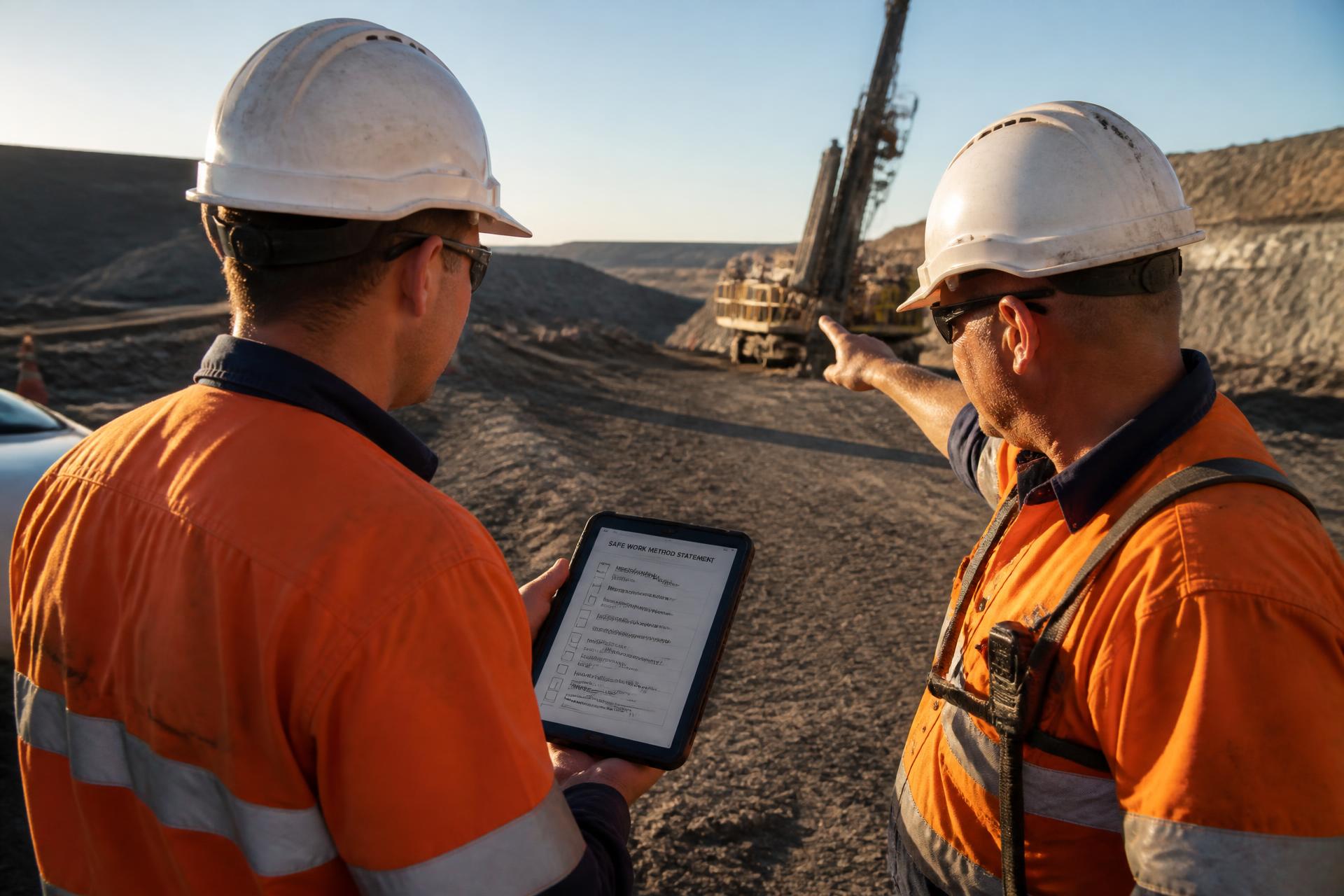
Run the pre-start briefing against the SWMS and capture each worker's sign-on on a phone or tablet, with time, date and location. A photographed paper register is not a searchable record.
Review when the job or the risk changes
Scope change, new plant, a near miss, an incident, a change in weather or crew, or a control that isn't working — each triggers a review, a new version and a re-brief with fresh sign-ons.
Store it against the job, the worker and the client
When a client audits or an incident occurs, you need the exact version that applied on the day, who signed it, and which job it belonged to — retrievable in minutes, not days.
Best practice for mining contractors
One controlled source, one version number
SWMS copied into email chains and USB sticks produce contradictory versions. Keep a single controlled document with a version history everyone works from.
Write it for the crew, not the auditor
If the fitters can't follow it at 5am, the controls won't be applied. Short steps, plain language, real control detail — that reads better in an audit too.
Reference the site's own procedures
Cite the mine's isolation procedure, permit system, traffic management plan and PHMPs by name. It shows alignment and speeds up client review.
Attach the evidence the SWMS relies on
Plant inspection records, SDSs, competency tickets and permits should be linked, not assumed. Otherwise the SWMS asserts controls you can't prove existed.
Make the sign-on impossible to skip
Gate the job start behind the SWMS briefing in your field app, so no timesheet or task starts without a recorded sign-on.
Audit your own SWMS quarterly
Pull five recent SWMS at random and check they were site-specific, consulted, signed by everyone on site and reviewed after changes. Fix the pattern, not the document.
Common mistakes
Generic templates with the site name changed
The most common client rejection. A SWMS that could apply to any site describes no real hazards and provides no defence.
No consultation record
A SWMS prepared in the office by one person and emailed out breaches the consultation requirement, regardless of how good the content is.
Missing sign-ons for late arrivals
Workers who join a job mid-shift or mid-swing routinely miss the briefing. Every person on the task needs a recorded sign-on before they start.
Never reviewed after a scope change
Scope creep with an unchanged SWMS means the crew is working outside its documented controls — the exact scenario regulators pursue.
Only stored in the client's portal
When the contract ends, so does access. Keep your own copy of every SWMS and sign-on register.
Controls that name PPE first
Leading with gloves and glasses signals the hierarchy of control wasn't applied. Elimination, isolation and engineering controls come first.
Related reading: How long should mining safety records be kept · How to manage fatigue records in mining · Health & safety software · Staff & competency management.
SWMS for mining contractors — FAQs
This article is general information for Australian mining and heavy industry contractors, not legal advice. Confirm your SWMS obligations with your state regulator, the mine operator and your own WHS advisers.