Quick Answer
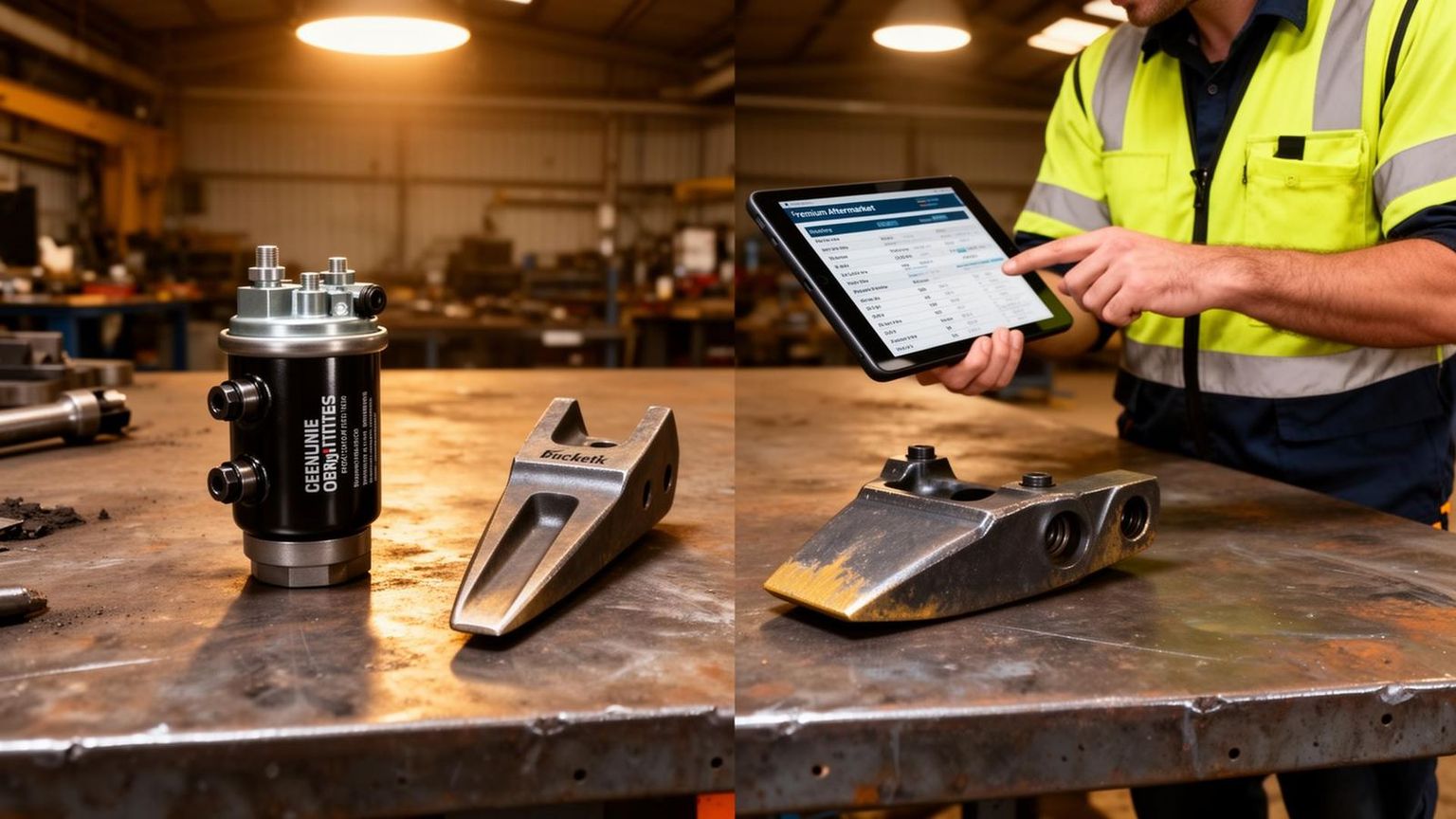
To compare OEM vs aftermarket mining parts properly: check warranty/MARC status first (OEM only if in scope), pull the OEM part number from the manufacturer's catalogue, cross-reference into premium aftermarket catalogues (Bradken, ESCO, CR Mining, Donaldson, Berco, Parker), verify the spec matches or exceeds OEM, and compare on cost-per-hour using the hours/tonnes from the asset history — not sticker price. OEM meaning in mining = Original Equipment Manufacturer (Cat, Komatsu, Hitachi, Liebherr, Volvo). Aftermarket vs genuine parts differ by manufacturer and brand, not necessarily by performance.
- OEM means: Original Equipment Manufacturer — Cat, Komatsu, Hitachi, Liebherr, Volvo, Sandvik
- Genuine = OEM: Same thing, different word
- Premium aftermarket: Bradken, ESCO, CR Mining, Donaldson, Berco, Parker
- Decision metric: Cost-per-hour / tonnes-per-part, not sticker price
The OEM vs aftermarket debate is one of the longest-running arguments in mining maintenance — and it's also one contractors regularly get wrong by comparing on sticker price. Done properly, the comparison is a six-factor decision that includes safety, warranty, spec, supplier reputation, lead time and (last) cost-per-hour.
This guide covers the OEM meaning in mining, what separates aftermarket from genuine parts, what the Reddit consensus actually says (and where it's right and wrong), and the practical decision matrix Australian mining contractors use to choose between the two.
OEM meaning in mining
OEM in mining stands for Original Equipment Manufacturer — the company that built the machine. In Australian mining, the major OEMs are:
- Caterpillar (Cat) — via WesTrac (WA/NSW/ACT) and Hastings Deering (QLD/NT)
- Komatsu — Komatsu Australia, direct nationwide
- Hitachi — Hitachi Construction Machinery Australia (HCA)
- Liebherr — Liebherr Australia, direct nationwide
- Volvo CE — CJD Equipment
- Sandvik — direct, with hubs in Perth and Mackay
- Epiroc — direct, drill rig and underground specialist
A genuine part is an OEM part — made or authorised by the manufacturer, carrying their part number, sold through their dealer network. The terms "genuine" and "OEM" are used interchangeably in Australian mining.
Aftermarket vs genuine parts: what's actually different?
| Factor | Genuine (OEM) | Premium aftermarket |
|---|---|---|
| Manufacturer | Built or authorised by the OEM (Cat, Komatsu, Hitachi) | Independent specialist (Bradken, ESCO, CR Mining, Donaldson) |
| Part number | OEM number on the box | Aftermarket number, cross-referenced to OEM |
| Spec | OEM design and alloy | Often matches or exceeds OEM; sometimes proprietary alloy |
| Price | Higher (full dealer margin) | Typically 20–50% lower |
| Warranty cover | Required while machine is under OEM warranty/MARC | Fine once out of warranty, with traceability |
| Lead time | Dealer stock, dealer freight | Often faster on consumables from specialist hubs |
| Best for | Safety-critical, major components, in-warranty | GET, filters, hoses, undercarriage, bearings, wear plate |
What does Reddit say about OEM vs aftermarket?
Search "OEM vs aftermarket Reddit" and you'll land on threads in r/HeavyEquipment, r/Construction, r/mining and r/Diesel. Stripping the noise, the consensus among experienced operators and mechanics is consistent:
- OEM while under warranty or MARC. Nobody on Reddit recommends gambling a dealer warranty for a $200 filter saving.
- Premium aftermarket is widely trusted on out-of-warranty consumables — Bradken, ESCO, CR Mining, Donaldson, Berco, Parker get name-checked repeatedly.
- Generic "will-fit" parts are a false economy on hydraulics, brakes, bearings and high-pressure circuits.
- Cost-per-hour is the metric — multiple threads explicitly warn against comparing on sticker price.
- OEM dealers often quietly resell aftermarket — particularly filters and seals — which contractors discover on closer inspection of the box.
Reddit gets it wrong when individual threads generalise from one mine, one OEM dealer, or one bad aftermarket experience. Your own asset history is the only data that actually proves OEM vs aftermarket in your conditions.
OEM vs aftermarket decision matrix
| Scenario | Genuine (OEM) | Aftermarket |
|---|---|---|
| Warranty status | OEM only if under active OEM warranty or MARC | Premium aftermarket once out of warranty |
| Safety-critical (brakes, steering, ROPS, fire suppression) | OEM only | Avoid aftermarket |
| Major components (engine, pump, transmission) | OEM via dealer (core credit, rebuild support) | Specialist rebuilders only |
| GET (teeth, adapters, shrouds, edges) | OEM as baseline | Premium aftermarket often outperforms (Bradken, ESCO, CR Mining) |
| Filters (engine, hydraulic, fuel, air) | OEM as baseline | Donaldson, Baldwin, Fleetguard cross-references |
| Hoses & fittings | OEM for warranty/safety circuits | Parker, Gates, RYCO, Pirtek, Enzed for the rest |
| Undercarriage | OEM under warranty | Berco, ITM, Bradken out of warranty |
| Bearings & power transmission | OEM as baseline | SKF, Timken, NSK, NTN equivalents |
| Wear plate & liners | OEM as baseline | Bisalloy, Hardox, Bradken / ESCO mill liners |
How to compare OEM vs aftermarket: step by step
1. Confirm warranty and contract status
Before anything else, check whether the machine is under active OEM warranty or a Maintenance and Repair Contract (MARC). If yes, default to OEM (genuine parts) for everything in scope — the warranty/contract is worth more than the parts saving.
2. Pull the OEM part number from the parts catalogue
Look up the genuine OEM part number in the manufacturer's parts catalogue — Parts.Cat.Com (Cat), MyKomatsu (Komatsu), Hitachi Parts.it (Hitachi), LIDOS (Liebherr) or Volvo Genuine Parts. The OEM number is the universal reference every aftermarket supplier cross-references against.
3. Run an aftermarket cross-reference
Run the OEM number through aftermarket cross-reference catalogues — Bradken, ESCO, CR Mining and Hensley for GET; Berco for undercarriage; Donaldson, Baldwin and Fleetguard for filters; Parker, Gates and RYCO for hoses. Confirm the cross is for your exact serial range, not just the model.
4. Compare spec, not just fit
Verify the aftermarket part matches or exceeds the OEM spec — alloy grade for GET, beta-ratio and micron for filters, SAE/EN rating for hoses, ISO/DIN class for bearings, NAS cleanliness for hydraulics. A part that fits but is under-spec'd will fail faster and cost more per hour than genuine.
5. Compare on cost-per-hour, not sticker price
Pull the hours and tonnes on the part being replaced from the asset history. Divide the quoted aftermarket and OEM prices by expected life in hours or tonnes — that's the real cost comparison. A 30% cheaper aftermarket part that runs 40% fewer hours is more expensive than genuine.
6. Raise a PO against the machine and job
Raise the purchase order in your job and asset management software against the specific machine and the active job. Attach the OEM number, the aftermarket cross-reference, the supplier quote and the hours/tonnes from the part being replaced. This is what makes the next OEM vs aftermarket decision data-driven instead of opinion-driven.
Tying every parts decision back to the asset
The only way to win the OEM vs aftermarket argument in your own fleet is data. In SprintSuite Procurement, supervisors raise a PO against the machine and the active job in seconds, attach the OEM and aftermarket part numbers, and record the hours and tonnes on the part being replaced. The PO matches the supplier invoice, and the parts cost flows into job management and the parts history of the machine in asset management.
Over a few change-out cycles, cost-per-hour for OEM vs premium aftermarket becomes visible against each asset — and at the next supplier review, you walk in with the data instead of an opinion.
Frequently asked questions
Win the OEM vs aftermarket argument with data
SprintSuite gives Australian mining contractors a single place to raise parts POs, attach OEM and aftermarket cross-references, match supplier invoices and benchmark cost-per-hour across the fleet.
Book a demo