
Quick Answer
MYOB EXO is MYOB's on-premise business management platform, while MYOB Acumatica is its cloud ERP platform for mid-sized organisations. Both cover broad financial and operational ground, so the central difference is architecture — how the software is deployed, accessed, updated and integrated — rather than a simple feature count.
- MYOB Advanced was renamed MYOB Acumatica; they are the same product lineage
- MYOB Acumatica is the Australia and New Zealand version of the global Acumatica platform
- MYOB provides migration tooling (MYOB Adapt) covering EXO Business to MYOB Acumatica Business
- Being encouraged to consider Acumatica is not the same as EXO being formally discontinued
- Moving everything from EXO into another all-in-one ERP is not the only architecture worth assessing
MYOB EXO vs MYOB Acumatica at a glance
A neutral summary based on how MYOB currently positions each product. There is no winner column here deliberately — the right answer depends on your requirements, not a scorecard.
| Consideration | MYOB EXO | MYOB Acumatica |
|---|---|---|
| Platform | On-premise business management software | Cloud ERP |
| Target | Growing and more complex businesses | Mid-sized businesses |
| Deployment | Primarily on-premise | Cloud-native |
| Finance | Yes | Yes |
| Payroll | Available | Available |
| Inventory | Yes | Yes |
| Projects | Project costing functionality | Project accounting and project functionality |
| CRM | Customer management available | Integrated CRM |
| Field / service | Service management functionality | Field services functionality available |
| Customisation | Configurable, customisable environment | Customisable cloud platform |
| MYOB migration pathway | Existing / source system | MYOB provides tooling to migrate EXO Business data toward MYOB Acumatica |
Platform
- MYOB EXO
- On-premise business management software
- MYOB Acumatica
- Cloud ERP
Target
- MYOB EXO
- Growing and more complex businesses
- MYOB Acumatica
- Mid-sized businesses
Deployment
- MYOB EXO
- Primarily on-premise
- MYOB Acumatica
- Cloud-native
Finance
- MYOB EXO
- Yes
- MYOB Acumatica
- Yes
Payroll
- MYOB EXO
- Available
- MYOB Acumatica
- Available
Inventory
- MYOB EXO
- Yes
- MYOB Acumatica
- Yes
Projects
- MYOB EXO
- Project costing functionality
- MYOB Acumatica
- Project accounting and project functionality
CRM
- MYOB EXO
- Customer management available
- MYOB Acumatica
- Integrated CRM
Field / service
- MYOB EXO
- Service management functionality
- MYOB Acumatica
- Field services functionality available
Customisation
- MYOB EXO
- Configurable, customisable environment
- MYOB Acumatica
- Customisable cloud platform
MYOB migration pathway
- MYOB EXO
- Existing / source system
- MYOB Acumatica
- MYOB provides tooling to migrate EXO Business data toward MYOB Acumatica
What is MYOB EXO?
MYOB EXO is an on-premise business management platform for organisations that need more than basic accounting software. MYOB describes it as flexible, on-premise business management software, and lists functionality spanning areas including finance, payroll, customer management, inventory, project costing, manufacturing and service management.
In practice, EXO tends to be found in businesses that outgrew entry-level accounting packages some years ago — engineering firms, contractors, distributors, manufacturers and service organisations with multi-entity structures, stock, projects or complex payroll requirements.
The defining characteristic of most mature EXO environments isn't the standard product; it's everything that has been built around it. Long-running EXO sites are often highly customised, with bespoke reports, add-ons, integrations and business processes accumulated over a decade or more. Some of that customisation is genuinely valuable intellectual property. Some of it exists because of a limitation that was worked around in 2014 and never revisited.
That distinction matters enormously when comparing EXO with any newer platform, because you're rarely comparing two products. You're comparing your configured EXO environment with a platform that would need to be configured to match — or deliberately not match.
If you're specifically researching the future of EXO, see our guide: Is MYOB EXO End of Life?
Source: MYOB EXO product information
What is MYOB Acumatica?
MYOB Acumatica is MYOB's cloud ERP platform for mid-sized businesses in Australia and New Zealand. MYOB states that it is the ANZ version of the global Acumatica platform, delivered locally by MYOB and its partner network.
As a cloud ERP, it is designed to bring financial and operational functions together in one platform rather than a collection of separately installed modules. MYOB's current material describes functionality across areas including:
Financial management
Payroll
Workforce management
Inventory and distribution
CRM
Project accounting
Purchase order management
Reporting and business intelligence
Field services
Manufacturing
Construction
Other industry solutions
MYOB also presents industry-specific solutions, including construction, manufacturing, field services and wholesale/distribution. As with any ERP, the capability that matters is the capability you actually implement and configure — the published functionality list describes what is possible, not what you'll have on day one.
Is MYOB Advanced the same as MYOB Acumatica?
Yes. MYOB Advanced was renamed MYOB Acumatica. MYOB states that both names refer to the same product, with the rename aligning the MYOB product more closely with the underlying Acumatica platform. If your internal documents, quotes or partner proposals still say "MYOB Advanced", they're describing the same ERP lineage.
The biggest difference: on-premise vs cloud ERP
Feature lists between mature ERP products tend to converge. Architecture doesn't. MYOB currently describes EXO as on-premise business management software and Acumatica as a cloud ERP, and almost every practical difference between the two flows from that single distinction.
MYOB EXO — on-premise
The software runs in an environment your business (or your IT provider) is responsible for. That gives a high degree of control over configuration, customisation, data location and upgrade timing — and it places infrastructure, access and continuity decisions with you.
MYOB Acumatica — cloud ERP
The platform is cloud-hosted and designed around browser and device access, with a modern API and integration model. Infrastructure responsibility shifts toward the platform, and the environment is designed to be extended through the cloud ecosystem rather than local installs.
| Consideration | MYOB EXO | MYOB Acumatica |
|---|---|---|
| Core architecture | On-premise | Cloud |
| Infrastructure | Your business / IT environment plays a larger role | Cloud-hosted platform |
| Access | Depends on how the environment has been configured | Designed for browser and device access |
| Updates | Traditional desktop / on-premise environment | Cloud ERP model |
| Integrations | Existing integrations and customisations vary by site | Modern API and integration ecosystem |
| Migration | Existing system | Requires implementation and migration when moving |
Core architecture
- MYOB EXO
- On-premise
- MYOB Acumatica
- Cloud
Infrastructure
- MYOB EXO
- Your business / IT environment plays a larger role
- MYOB Acumatica
- Cloud-hosted platform
Access
- MYOB EXO
- Depends on how the environment has been configured
- MYOB Acumatica
- Designed for browser and device access
Updates
- MYOB EXO
- Traditional desktop / on-premise environment
- MYOB Acumatica
- Cloud ERP model
Integrations
- MYOB EXO
- Existing integrations and customisations vary by site
- MYOB Acumatica
- Modern API and integration ecosystem
Migration
- MYOB EXO
- Existing system
- MYOB Acumatica
- Requires implementation and migration when moving
Neither model is automatically better. On-premise environments can be extremely stable and deeply tailored; cloud platforms can simplify access and reduce infrastructure ownership. What changes is where responsibility sits, how users reach the system, and how new functionality is delivered over time.
Is MYOB EXO cloud based?
MYOB currently describes MYOB EXO as on-premise business management software rather than a cloud-native ERP.
That said, plenty of EXO customers do access the system remotely. Individual businesses may have configured remote desktop access, private or partner hosting, VPN access or connected services around their EXO environment, and for day-to-day users that can feel similar to using cloud software.
The distinction still matters. Accessing EXO remotely does not necessarily make the underlying product cloud-native in the same way as MYOB Acumatica. Hosting changes where the software runs; it doesn't change the deployment model the product was designed around.
MYOB EXO vs MYOB Acumatica features
Both products cover a lot of the same functional ground, so this comparison is deliberately descriptive rather than declaring a winner in each row. Where a capability depends on configuration — and in ERP, most of them do — that is stated.
| Consideration | MYOB EXO | MYOB Acumatica |
|---|---|---|
| Financial management | MYOB positions EXO as business management software covering finance for businesses that have outgrown basic accounting packages. | MYOB positions financial management as a core part of the Acumatica cloud ERP. |
| Payroll | MYOB lists payroll among current EXO functionality. | MYOB offers MYOB Acumatica Payroll within its enterprise range. |
| Projects and job costing | Project costing functionality is part of the EXO feature set. | Project accounting is part of the Acumatica functionality set. |
| Inventory | Inventory functionality is listed by MYOB. | Inventory and distribution functionality is listed by MYOB. |
| CRM | Customer management functionality is available. | CRM is presented as part of the platform. |
| Manufacturing | Manufacturing functionality is listed by MYOB. | Manufacturing is one of the industry solution areas MYOB presents. |
| Service and field operations | Service management functionality is listed by MYOB. | Field services functionality is presented as available. |
| Reporting | Reporting depends heavily on the configuration and customisation built up over time. | Reporting and business intelligence are presented as part of the cloud platform. |
| Mobile and remote access | Depends on how each business has configured access, hosting or remote connections. | Designed around browser-based access to a cloud platform. |
| Customisation and integration | Mature EXO environments are often highly customised, with integrations built up over years. | Customisation and integration are approached through a modern cloud API model. |
Financial management
- MYOB EXO
- MYOB positions EXO as business management software covering finance for businesses that have outgrown basic accounting packages.
- MYOB Acumatica
- MYOB positions financial management as a core part of the Acumatica cloud ERP.
Payroll
- MYOB EXO
- MYOB lists payroll among current EXO functionality.
- MYOB Acumatica
- MYOB offers MYOB Acumatica Payroll within its enterprise range.
Projects and job costing
- MYOB EXO
- Project costing functionality is part of the EXO feature set.
- MYOB Acumatica
- Project accounting is part of the Acumatica functionality set.
Inventory
- MYOB EXO
- Inventory functionality is listed by MYOB.
- MYOB Acumatica
- Inventory and distribution functionality is listed by MYOB.
CRM
- MYOB EXO
- Customer management functionality is available.
- MYOB Acumatica
- CRM is presented as part of the platform.
Manufacturing
- MYOB EXO
- Manufacturing functionality is listed by MYOB.
- MYOB Acumatica
- Manufacturing is one of the industry solution areas MYOB presents.
Service and field operations
- MYOB EXO
- Service management functionality is listed by MYOB.
- MYOB Acumatica
- Field services functionality is presented as available.
Reporting
- MYOB EXO
- Reporting depends heavily on the configuration and customisation built up over time.
- MYOB Acumatica
- Reporting and business intelligence are presented as part of the cloud platform.
Mobile and remote access
- MYOB EXO
- Depends on how each business has configured access, hosting or remote connections.
- MYOB Acumatica
- Designed around browser-based access to a cloud platform.
Customisation and integration
- MYOB EXO
- Mature EXO environments are often highly customised, with integrations built up over years.
- MYOB Acumatica
- Customisation and integration are approached through a modern cloud API model.
A note on comparison language: claims like "EXO can't do mobile" or "Acumatica is easier" don't survive contact with real implementations. Two businesses running the same product can have completely different experiences depending on configuration, partner, data quality and adoption. Assess against your own processes, not a generic feature matrix.
Why are EXO users being encouraged to look at Acumatica?
If it feels like Acumatica is suddenly everywhere in your MYOB conversations, that's not imagination. Several things are happening at once:
- MYOB is clearly investing in its cloud ERP offering as its forward-looking enterprise platform.
- MYOB has created dedicated migration tooling and processes for on-premise customers.
- MYOB's current EXO material itself points readers toward exploring MYOB Acumatica.
- MYOB is publishing guidance about moving from mature desktop and on-premise ERP environments into cloud ERP.
Important
This does not automatically mean MYOB EXO has formally reached end of life. A vendor promoting its newer platform and a vendor publishing an end-of-life notice are two different things, and the difference matters when you're planning budget and timelines.
Can you migrate from MYOB EXO to MYOB Acumatica?
Yes — MYOB provides a migration pathway. MYOB Adapt is designed to simplify migrations from on-premise MYOB solutions into MYOB Acumatica, and current MYOB documentation specifically references EXO Business → MYOB Acumatica Business.
That's genuinely useful: the existence of a supported pathway removes a lot of uncertainty about whether your data can move at all. What it doesn't remove is the project around the data.
Data quality
Historical records
Configuration
Workflows
Integrations
Customisations
Reporting
Testing
Training
Implementation
Change management
Migration is not the same as copying your old system into the cloud.
A migration is an opportunity to decide which processes should actually survive. Most businesses only get that opportunity once every ten or fifteen years.
What should you review before moving from EXO to Acumatica?
Work through this before you sit down with any vendor or partner. It changes the quality of the conversation considerably.
Current EXO modules
What do you actually use — and what was licensed years ago and quietly abandoned?
Customisations
Which still solve a genuine business problem, and which exist because of an old limitation?
Integrations
What connects to EXO today, and what data moves manually between systems?
Historical data
What genuinely needs to migrate, versus what should be archived and readable?
Reports
Which reports are genuinely used to make decisions each month?
Operational workarounds
What currently happens in Excel, on paper or in separate applications?
Field workflows
How do employees away from the office interact with systems today?
Workshop workflows
What does the workshop actually need to see, record and hand back?
Finance requirements
Which processes genuinely need to live inside the ERP itself?
User adoption
Will the people doing the work actually use the proposed system?
MYOB Acumatica reviews: what should you actually evaluate?
If you're searching for MYOB Acumatica reviews, don't judge an ERP on a star rating alone. Your implementation, configuration and business requirements will have a major influence on the outcome — often more influence than the product itself.
We don't publish scores we can't stand behind, so instead here's the evaluation framework we'd use in your position:
Product fit
Does the platform genuinely support your core operational and financial requirements — not a generic feature list?
Implementation partner
Who will configure and implement the system, and what is their experience in your industry?
Customisation
How much of the standard product needs to change before it fits how you work?
Integrations
What must connect — payroll, CAD, plant systems, supplier portals, operational software?
User experience
What will everyday users actually see and click, dozens of times per day?
Field usability
What happens away from the office, on a phone, sometimes without reliable coverage?
Reporting
Can decision-makers get the numbers they need without exporting to a spreadsheet first?
Total implementation scope
What is required beyond the software licence to be genuinely live?
Support
Who provides ongoing support once the implementation team leaves?
Future roadmap
Does the architecture suit where the business is heading in five years?
For an EXO customer, the most useful review isn't "Is Acumatica good?" It's "Is Acumatica the right fit for the specific jobs our current EXO environment performs?"
How much does MYOB Acumatica cost?
MYOB Acumatica pricing depends on the solution your business requires, so comparing ERP cost should include implementation and ongoing ownership — not just the software licence. We won't publish a per-user figure here, because a number quoted without scope is worse than no number at all.
ERP cost typically depends on factors such as:
Business size
Solution scope
Modules required
Implementation effort
Configuration
Integrations
Customisation
Support arrangements
Data migration
Compare total cost of ownership, not licence cost
When you build the comparison, include every line that will hit the budget over the first three years:
The cheapest licence is not necessarily the cheapest migration.
For current pricing guidance, work from MYOB's own material and a scoped partner quote: MYOB ERP software information
MYOB EXO vs MYOB Acumatica: which is better?
There isn't a universal winner. MYOB EXO may continue to suit businesses whose existing environment is stable, supported and meeting their requirements. MYOB Acumatica may be worth considering for businesses deliberately moving toward a modern cloud ERP architecture.
The decision depends on:
Business requirements
Growth plans
Existing customisation
Integrations
Implementation appetite
Operational complexity
Field and workshop requirements
Cost
Timeline
Future technology strategy
And there is another question worth asking before choosing either approach:
Does every operational workflow need to live inside the ERP at all?
Before moving everything into another ERP, separate finance from operations
MYOB Acumatica is explicitly designed to bring many business functions into one cloud ERP. For some organisations, that all-in-one approach will make sense — a single platform, a single vendor relationship, one place for the data.
For others — particularly businesses with complex field, workshop and project operations — it may be worth considering whether finance and day-to-day operational work need to live in the same platform at all.
All-in-one ERP approach
One cloud ERP platform
- Finance
- Payroll
- Projects
- Inventory
- Operations
- CRM
Connected specialist approach
Operations platform + finance platform
SprintSuite — operations
- Jobs & projects
- Workshop
- Scheduling
- Field teams
- Timesheets
- Job costing
- Purchase orders
- Assets
- Safety
Accounting / ERP platform — finance
- General ledger
- Accounts
- Tax
- Statutory reporting
- Financial control
Neither model is objectively better. The right model depends on the business — how much of your work happens away from a desk, how specialised your operational workflows are, and how many people would need an ERP licence purely to record operational information.
What does SprintSuite add to the conversation?
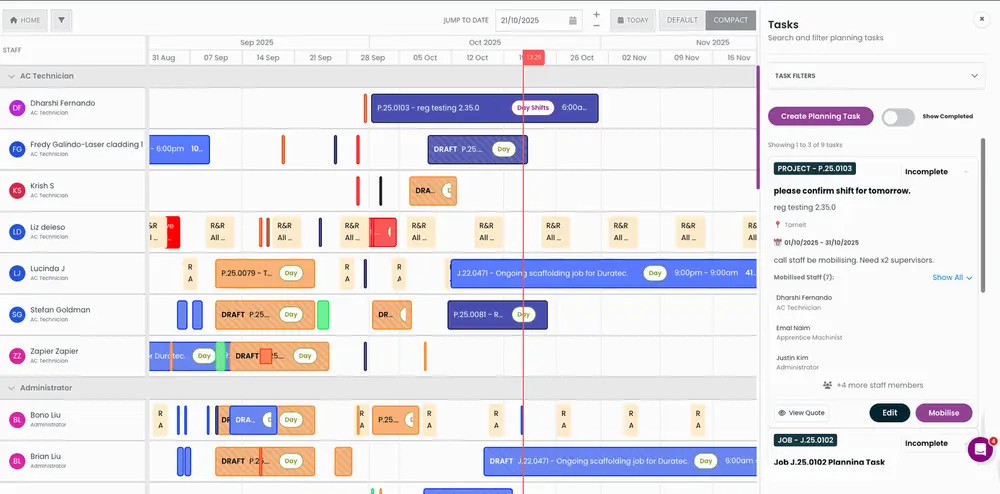
SprintSuite isn't another general-purpose financial ERP. It's built around businesses where work moves between the office, the workshop and the field — mining contractors, engineering businesses, maintenance contractors, fabrication shops, field service teams and heavy industry more broadly.
It doesn't replace your general ledger, and it isn't intended to. It sits where the work actually happens, and connects that work back to finance.
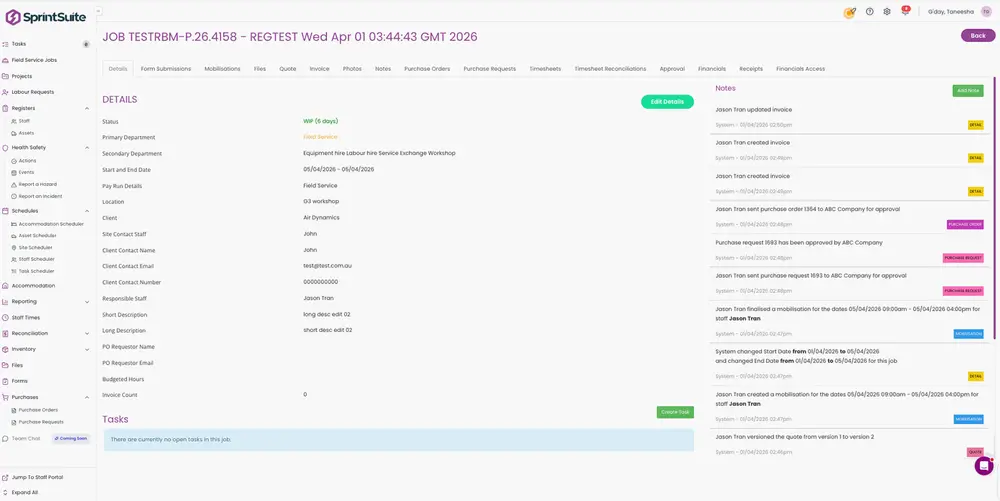
Jobs & Projects
Jobs, labour, materials, costs and progress in one operational workflow.
Workshop
Work in progress, technicians, parts and job status on the workshop floor.
Field Teams
Job information in the hands of crews working away from the office.
Scheduling
Coordinate people, equipment and jobs from one operational view.
Timesheets
Capture labour against the right job from mobile or a workshop kiosk.
Job Costing
Connect labour, purchasing and cost back to the work while it's running.
Purchasing
Keep purchase orders attached to the job generating the spend.
Assets
Keep equipment records, servicing and allocation close to the work.
Safety
Pre-starts, hazards and field forms alongside the jobs they belong to.
Mobile Workflows
A mobile experience designed around operational work, including poor coverage.
SprintChat
Office, workshop and field conversations connected to the same platform.
EXO to Acumatica isn't just a software upgrade decision
If your business has used EXO for years, the temptation may be to recreate the same processes inside Acumatica. It feels safe, it shortens the requirements workshops, and nobody has to argue about how things should work.
But a major system change is one of the few opportunities you'll get to question the architecture itself. Ask:
Which processes still make sense?
Which exist only because of historical system limitations?
Which have quietly moved into spreadsheets?
Which are only ever used by finance?
Which are genuinely operational?
Which users need mobile access?
Which workflows should be simplified?
Which customisations should disappear?
Which systems genuinely need to integrate?
Don't migrate your workarounds. Redesign the workflow.
When might MYOB Acumatica make sense?
Considerations rather than guarantees — but these are the situations where a move to MYOB Acumatica tends to be worth serious assessment:
- You want a cloud ERP and have decided that architecture is the direction
- You want broad financial and operational functionality inside one ERP environment
- You need substantial ERP capability across multiple departments
- Your business is comfortable undertaking a full ERP implementation
- You want to remain within the MYOB enterprise ecosystem
- Your requirements are well supported by the industry and functionality stack MYOB presents
When might you consider a different approach?
Equally, there are situations where putting every workflow inside one ERP is the harder path:
- Field adoption is the priority, not head-office functionality
- Workshop operations sit at the centre of how the business earns money
- Operational teams need specialised workflows rather than generic ERP screens
- Finance and operations have very different user needs
- You don't necessarily want every employee working inside a broad ERP
- Existing ERP processes are already supplemented by many operational workarounds
- You want to simplify, rather than expand, your technology architecture
- A dedicated operational platform connected to finance may be a better fit
Still not sure Acumatica is the right fit? Compare MYOB Acumatica alternatives and how a connected operations platform changes the architecture.
Questions to ask before an EXO to Acumatica migration
Take this list into the room. If a proposal can answer all seventeen, it's a plan; if it can't, it's a quote.
- Why are we migrating?
- What problem are we actually trying to solve?
- Has MYOB given us a specific product or support timeline in writing?
- Which EXO modules do we actually use?
- What already happens outside EXO?
- Which customisations genuinely need to survive?
- How much historical data really needs to migrate?
- What will implementation cost?
- What will integrations cost?
- What will internal staff time cost?
- How will field workers use the new system?
- How will workshop staff use it?
- Will project managers get better operational visibility?
- Do all users actually need an ERP licence?
- Could finance and operations be separated?
- What does the future system architecture look like?
- How will we measure whether the migration was successful?
Reviewing what comes after MYOB EXO?
Before simply recreating your EXO environment in another ERP, take the opportunity to look at how your jobs, projects, workshop and field teams should actually operate.
SprintSuite is built for Australian mining, engineering and field-service contractors that need stronger operational visibility from the office to the field.
Bring your current workflow. We'll show you what it could look like in SprintSuite.
MYOB EXO vs MYOB Acumatica FAQs
More MYOB Migration Resources
Is MYOB EXO End of Life?
Understand what's currently happening with EXO and what MYOB has publicly confirmed.
MYOB EXO Alternative
Explore another approach to replacing your operational EXO workflows.
MYOB Acumatica Alternative
If Acumatica may not be the right fit, see how an operations platform compares.
Is MYOB Greentree End of Life?
See what MYOB is currently saying about Greentree and cloud ERP migration.
MYOB Greentree Alternative
Explore options for operational workflows currently sitting around Greentree.
Already sending operational data into MYOB? See the best MYOB integrations for mining and engineering.
This article is general information based on publicly available MYOB product positioning as at August 2026. Always confirm functionality, support, licensing, pricing and roadmap details for your specific MYOB environment directly with MYOB or your authorised MYOB partner.