Quick Answer
World Lizard Day is 14 August. For Australian mining and heavy industry, it is a prompt to check that fauna obligations are being met on the ground. Key facts:
- World Lizard Day is 14 August — an awareness day for the world's lizards and their habitats
- Australia has more than 800 native lizard species, most found nowhere else
- Mining and heavy industry operate in prime lizard country — Pilbara, Goldfields, Bowen Basin, Hunter Valley, Mount Isa
- The EPBC Act and state biodiversity laws require fauna management plans, spotter-catchers and clearing controls
- Contractors need live evidence of fauna training, daily checks and closed-out environmental actions
What is World Lizard Day?
World Lizard Day is celebrated on 14 August each year. It is an awareness day for the world's lizards and their habitats — a group of reptiles under serious pressure from habitat loss, invasive species, climate change and land-use change. Australia is one of the most important lizard countries on Earth: we have more than 800 native lizard species, most of which are found nowhere else.
Why lizards matter for Australian mining and heavy industry
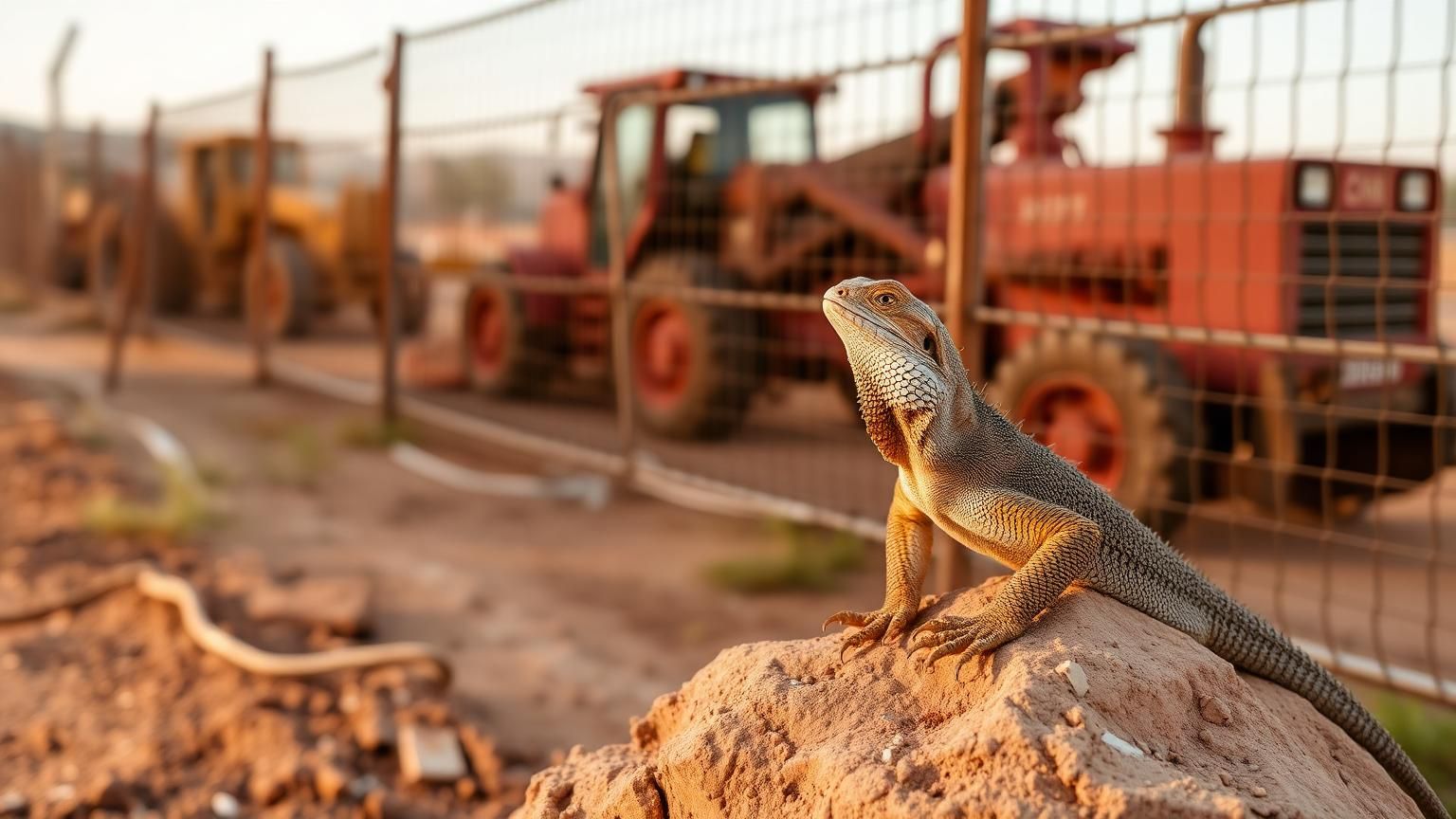
Australian mining operates in the exact landscapes where lizards live — the Pilbara, Goldfields, Kimberley, Bowen Basin, Hunter Valley, Mount Isa, Olympic Dam, Yilgarn and Cooper Basin. Iron ore, gold, coal, copper, uranium and critical minerals projects sit in habitats containing pygmy monitors, geckos, dragons, skinks and legless lizards. Under the EPBC Act and state biodiversity laws, operators and their contractors have obligations wherever those species turn up.
The species that share Australian mine sites
Some of the lizards you are most likely to encounter on or near operating sites include the Pilbara olive python's neighbours — bearded dragons (Pogona minor), Gould's monitor (Varanus gouldii), the Pilbara rock monitor and thorny devil in WA; blue-tongued lizards and eastern water dragons across QLD and NSW; and threatened species such as the great desert skink, Slater's skink, striped legless lizard (Melbourne to Riverina grasslands), pink-tailed worm-lizard (Canberra region quarries) and grassland earless dragon. Several are listed threatened under the EPBC Act.
What the law expects of operators and contractors
The EPBC Act 1999 protects matters of national environmental significance — including listed threatened reptiles. State laws (Biodiversity Conservation Act NSW, Nature Conservation Act QLD, Biodiversity Conservation Act WA, Flora and Fauna Guarantee Act VIC) add another layer. Operators need approvals, offsets, clearing permits, fauna spotter-catchers on ground-disturbance work, and evidence that contractor crews were inducted, briefed and compliant with the site's fauna management plan.
Practical controls on a mine site or heavy industry yard
The controls that show up in fauna management plans and Tier-1 contractor obligations include: pre-clearance surveys and fauna spotter-catchers on all vegetation clearing; escape ramps and daily fauna checks in trenches, sumps and open excavations; covered pipes and stockpiles overnight; speed limits on haul and access roads (lizards bask on warm roads); no relocation of rocks or logs without a spotter-catcher; and hard rules on no feeding, no handling, no taking.
What good looks like — beyond compliance
Leading operators go further than the minimum: progressive rehabilitation that puts habitat features (rocks, logs, spinifex) back onto reshaped landforms; biodiversity offsets with measurable species outcomes, not just hectares; partnerships with universities and Traditional Owners on species monitoring; and contractor training that treats fauna the same way it treats safety — briefed at pre-start, reported at handover.
What contractors should do for World Lizard Day
Use 14 August as a prompt to: refresh your fauna toolbox talk; confirm every crew going near ground disturbance knows the site's fauna management plan; check spotter-catcher bookings against upcoming clearing; audit that fauna checks are logged in your compliance system, not just on paper; and, on the day, share what species live on your site with your crews and clients on LinkedIn. It costs nothing and signals you are the kind of contractor a Tier-1 operator wants.
The commercial angle
Environmental performance is no longer a side conversation on Australian mining tenders. Scope 3, ESG, Modern Slavery and biodiversity now sit alongside HSE in prequalification. Contractors who can hand a client live evidence of fauna training completion, incident-free clearing, and closed-out environmental actions win work. The ones who can't, don't.
Related reading: World's Indigenous Peoples Day in mining · Tier-1 contractor expectations in 2026 · Australia Critical Minerals & Energy Transition 2026 · NSW Mining HSEC Conference 2026 · Contractor management system explained.