Quick Answer
The best trades for females in Australia in 2026 are in mining and heavy engineering — because that's where the shortages, the training subsidies and the money are. The strongest options:
- Heavy diesel fitter — $115k–$165k+, the deepest shortage in the country
- Boilermaker / heavy fabrication welder — $110k–$170k+ with shutdown work
- Mining electrician (HV) — $120k–$180k+, highest ceiling on site
- Auto electrician — $115k–$170k, chronic national shortage
- Mechanical fitter — $105k–$155k, best workshop-based option
- Rigging / dogging / crane — fastest entry, licences in weeks not years
Fastest route in: get a White Card, a Standard 11 induction and a Coal Board Medical, then apply to mining service contractors rather than only to the Tier-1 miners — contractors hire far more apprentices and hire year-round.
Why mining and engineering trades are the strongest option
"Trades for females" usually returns a list of hairdressing, horticulture and light domestic trades. That list is out of date. The trades with the largest pay packets, the deepest shortages and the most funded training places in Australia right now are heavy: diesel fitting, fabrication, electrical and fixed plant maintenance.
Three things have converged. Every Tier-1 operator — BHP, Glencore, Anglo American, Rio Tinto, BMA — now publishes gender-balance targets, and those targets flow down into the contractor workforce through tender requirements. At the same time, an ageing tradesperson cohort is retiring faster than apprentices are being signed. And automation has changed the physical reality of the work: modern mining maintenance is diagnostics, torque procedures and lifting equipment far more than brute force.
The result is a genuine shortage economy. Contractors across the Bowen Basin, Hunter Valley, Pilbara and Goldfields are competing for the same fitters and boilermakers — which is why an apprenticeship in these trades is one of the few remaining paths to six figures without a degree or a debt.
The 8 best trades for women in Australian mining and engineering
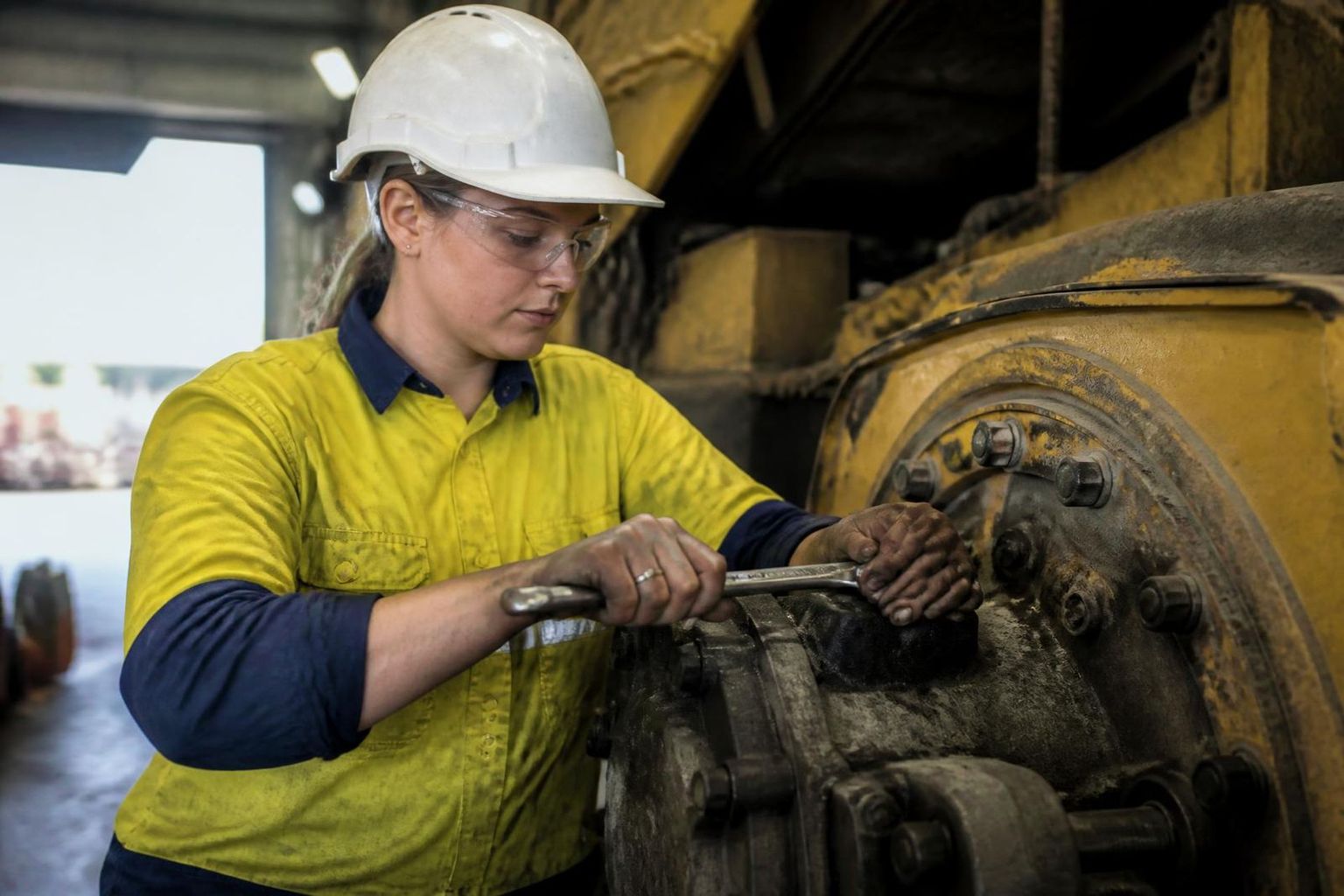
Heavy diesel fitter (mobile plant mechanic)
$115k–$165k+ on site; apprentices from ~$45k
The backbone trade of every mining contractor. Haul trucks, excavators, dozers and drills all need scheduled services, component changes and breakdown response. Demand across the Bowen Basin, Hunter Valley and Pilbara consistently outstrips supply.
Boilermaker / heavy fabrication welder
$110k–$170k+ with shutdown work; apprentices from ~$45k
Structural repairs, buckets, chutes, conveyor structures and shutdown fabrication. Coded welders with pressure or structural tickets are among the hardest roles for contractors to fill, and shutdown rates reflect that.
Electrician (mining / HV)
$120k–$180k+ with HV authority; apprentices from ~$45k
Highest-earning trade on most sites once high-voltage switching, instrumentation or automation is added. Fixed plant, conveyors, substations and control systems all need licensed electrical workers.
Fitter and turner / mechanical fitter
$105k–$155k; workshop and site roles
Pumps, gearboxes, conveyors, hydraulics and component rebuilds. Strong option for anyone who prefers workshop-based work with day shifts rather than a FIFO swing.
Auto electrician
$115k–$170k; very high demand
Modern mining fleets are rolling computers — auto sparkies handle diagnostics, wiring looms, fire suppression, GPS and collision-avoidance systems. Chronic national shortage.
Diesel fitter — fixed plant / CHPP
$110k–$160k; often DIDO from Mackay or Moranbah
Coal handling and preparation plants, crushers and conveyors run on planned maintenance and shutdowns. Good pathway into planning and supervision roles later.
Rigger, dogger and crane operator
$100k–$150k+ on shutdowns
Not a four-year apprenticeship — high-risk work licences can be earned in weeks and stacked. A fast entry into site work that pairs well with a later trade or into shutdown supervision.
Trade-adjacent: planner, scheduler and supervisor
$120k–$180k+
Where a lot of experienced tradeswomen end up, and where contractors are shortest of good people. Maintenance planning, shutdown scheduling and supervision reward pattern recognition and organisation as much as time on the tools.
Pay comparison at a glance (2026)
| Trade | Apprentice (yr 1) | Qualified (site) | Top end |
|---|---|---|---|
| Mining electrician (HV) | $45,000 | $130,000 | $180,000+ |
| Heavy diesel fitter | $45,000 | $125,000 | $165,000 |
| Boilermaker (shutdowns) | $44,000 | $120,000 | $170,000 |
| Auto electrician | $45,000 | $125,000 | $170,000 |
| Mechanical fitter | $44,000 | $115,000 | $155,000 |
| Rigger / crane operator | n/a (licence-based) | $110,000 | $150,000 |
Indicative total packages including site allowances and typical overtime, as at 2026. Rates are set by award, enterprise agreement or contractor rate — not by gender.
How to get started: six practical steps
1. Pick the trade, not just the industry
Heavy diesel, boilermaking, electrical and auto electrical are the four with the deepest shortages in Australian mining and heavy engineering. Choose based on whether you want site-based swings, workshop days, or a mix — the trade largely decides that.
2. Get the entry tickets early
A Standard 11 (or the equivalent state general induction), a Coal Board Medical for Queensland coal, a White Card, and a manual licence make you employable while you're still applying. Most contractors will pay for site-specific inductions, but arriving with the basics moves you up the list.
3. Apply to contractors, not just the miners
Tier-1 miners take a small number of apprentices each year with enormous application volumes. Mining service contractors — the workshops in Mackay, Moranbah, Muswellbrook, Kalgoorlie and Karratha — hire far more apprentices, train you across a wider variety of work, and are much easier to get a start with.
4. Use the women-in-trades pathways
Group training organisations, TAFE pre-apprenticeship programs, and mining-specific programs (BHP, Glencore, Anglo American and BMA all run gender-balance intakes) exist because operators have public targets. So do women-in-mining networks in Mackay, Emerald, Muswellbrook and Kalgoorlie — they are the fastest route to a referral.
5. Treat shutdowns as the accelerator
Shutdown work concentrates experience: in a 14-day shutdown you'll see more component changes than in three months of routine service. It also pays the best hourly rates. Say yes early and often in your first three years.
6. Know your region's rhythm
Bowen Basin work runs on shutdown calendars and DIDO from Mackay and Moranbah. The Pilbara is FIFO from Perth. The Hunter runs largely residential from Singleton and Muswellbrook. Where you're willing to live changes which trades and rosters are realistically available to you.
The tickets that get you on site
Whatever trade you choose, the same small set of credentials decides whether you can be scheduled to a Queensland coal site:
- Standard 11 general mining induction (or state equivalent for metalliferous sites)
- Coal Board Medical — valid five years, required for Queensland coal
- White Card for construction work
- Site-specific induction, usually arranged by your employer
- Manual driver's licence, and a 4WD or light vehicle site permit for many roles
- Role-specific tickets: working at heights, confined space, isolation, high-risk work licences, electrical licence and HV authority
Every one of these has an expiry date, and every one of them can stop you at the gate. Good contractors track them centrally so an expiring medical is flagged weeks out rather than the morning of a mobilisation — worth asking about in an interview, because it tells you a lot about how the business is run.
For contractors: attracting and keeping women in your workshop
If you run a mining service contracting business, the labour shortage is not going to solve itself out of the same pool you've always hired from. Widening the pool works — but only if the operation underneath it is worth staying in. The businesses that retain tradeswomen well tend to do these six things:
- Write job ads for the work, not the stereotype — remove 'strong bloke' language and unnecessary lifting requirements that aren't actually in the role.
- Fix the basics before the campaign: separate amenities, PPE that's actually cut for women, and correctly sized gloves and boots in the store.
- Publish rosters honestly. Predictable, visible rosters are the single most cited retention factor for women in trades, and they're a system problem, not a culture poster.
- Track competencies and tickets per person so development is visible — apprentices who can see their progression stay.
- Make the schedule and pay chain transparent. Hours captured on the shift and visible in the system removes the 'my timesheet got changed' conversation entirely.
- Measure retention, not just recruitment. Hiring more women into a workshop that loses them in 18 months is a churn cost, not a diversity outcome.
Most of that list is an operations problem rather than a culture problem. Rosters that change without warning, hours that get "adjusted" in a spreadsheet, tickets nobody tracks, and progression nobody can see are the things people leave over — and they're all fixed by running scheduling, competency tracking and labour capture in one system instead of five.
Related reading: Mining electrician wages in Australia · Boilermaker jobs in Mackay · Mining jobs in Mackay 2026.
Trades for females — FAQs
Pay figures are indicative Australian total packages as at 2026 and vary by employer, roster, site and enterprise agreement. Training package codes change periodically — confirm current qualifications with your registered training organisation or group training organisation.