How Do You Apply Fatigue Management Strategies in the Workplace?
A practical 7-step guide for mining and heavy industry businesses to embed fatigue controls into daily operations.
Quick Answer
To apply fatigue management strategies in the workplace, businesses must identify fatigue risks, implement control measures, monitor worker fatigue, and continuously review systems to ensure workers remain fit for duty. In high-risk industries like mining, fatigue management should be built into daily operations — not treated as a once-off policy.
7 Steps to Implement Fatigue Management
1. Identify Fatigue Risks
Start by identifying where fatigue is likely to occur. Common risks include:
- Long shifts or extended overtime
- Night shifts or rotating rosters
- Physically demanding work
- Remote or isolated job sites
2. Conduct a Fatigue Risk Assessment
Once risks are identified, assess:
- How likely fatigue is to occur
- The potential consequences (e.g. incidents, errors)
- Which roles or tasks are most exposed
This helps prioritise where controls are needed most.
3. Implement Control Measures
Control strategies should reduce fatigue risk as much as possible:
- Designing safer rosters with adequate rest
- Limiting consecutive shifts
- Providing rest breaks and fatigue facilities
- Managing workload and staffing levels
The goal is to minimise fatigue before it becomes a safety issue.
4. Introduce Monitoring Systems
Fatigue must be actively monitored, not assumed. Common methods include:
- Pre-start fatigue checklists
- Supervisor observations
- Self-reporting tools
- Digital fatigue tracking systems
This ensures workers who are not fit for work are identified early.
5. Train Workers and Supervisors
Workers need to understand:
- Signs of fatigue
- How fatigue impacts safety
- When and how to report it
Supervisors should also be trained to recognise fatigue and take action.
6. Use Technology to Support Fatigue Management
Modern workplaces are increasingly using systems to automate fatigue management:
- Digital pre-starts and checklists
- Automated scheduling and rostering
- Real-time reporting and alerts
- Integrated safety and compliance platforms
This reduces human error and improves visibility across sites.
7. Review and Improve Regularly
Fatigue management is not set-and-forget. Businesses should:
- Review incidents and near misses
- Analyse fatigue-related trends
- Update policies and controls regularly
Continuous improvement ensures fatigue risks are always managed effectively.
Why This Matters
Being awake for 17 hours can impair performance to the same level as a BAC of 0.05% — the legal driving limit in Australia. In mining, this increases the risk of equipment incidents, vehicle accidents, errors, and reduced reaction times.
Source: SafeWork SA →What Does Effective Fatigue Management Look Like?
An effective fatigue management system is:
It should be part of a broader safety and compliance strategy, not a standalone document.
The Bottom Line
Applying fatigue management strategies in the workplace means embedding fatigue controls into everyday operations — from rostering and pre-starts to reporting and compliance systems. For mining and heavy industry businesses, this isn't just best practice — it's critical for keeping workers safe, maintaining compliance, and preventing costly incidents.
Embed Fatigue Management Into Your Operations
SprintSuite helps you track hours, manage rosters, run digital pre-starts, and monitor fatigue risks — all in one platform.
Frequently Asked Questions
Related Articles
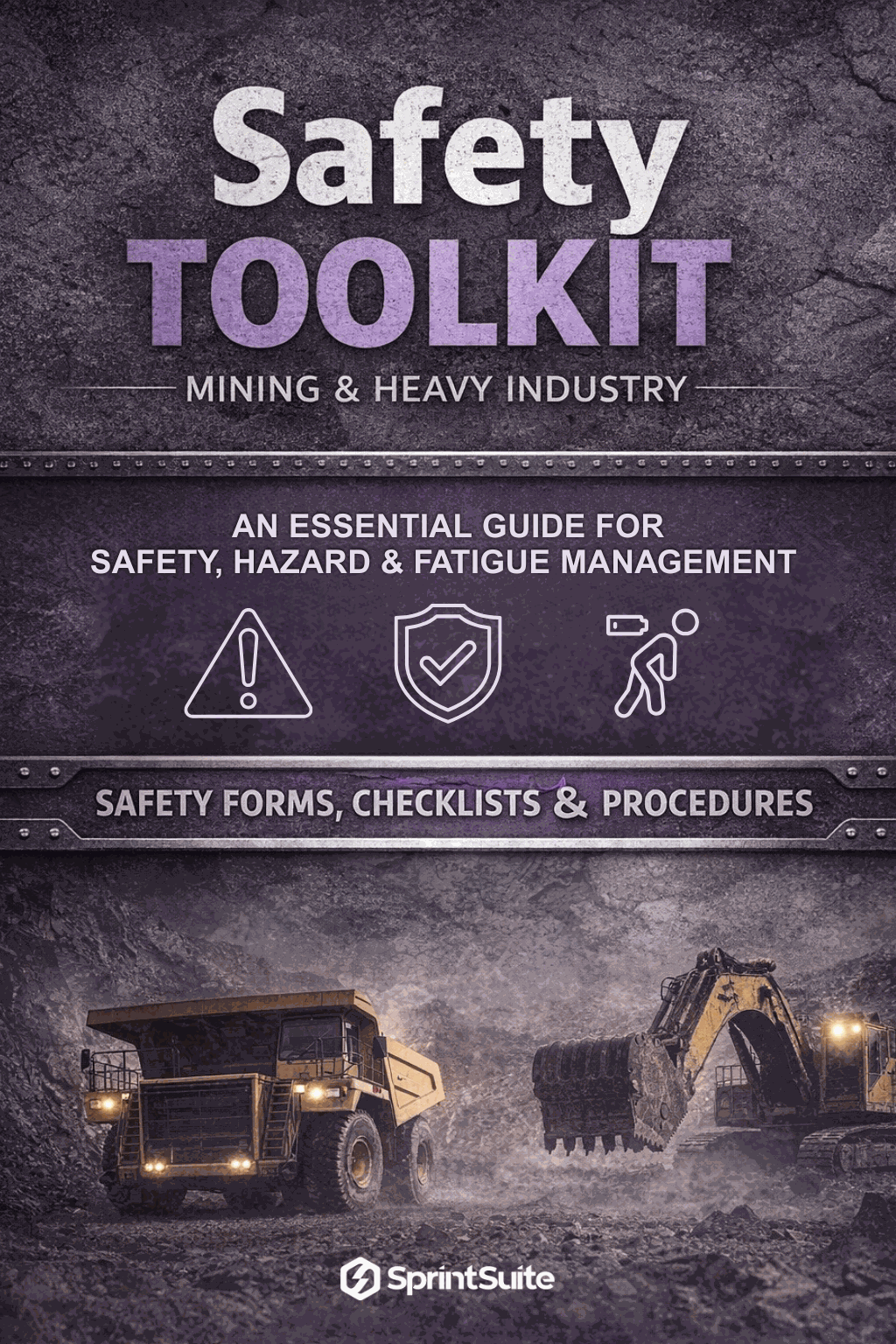
Try the paper version of mining safety — then upgrade to something better.
A free, ready-to-use toolkit of hazard reports, pre-start checklists, fatigue templates and toolbox guides — built for Australian mining and heavy industry crews. Perfect for getting compliant fast, but you'll quickly see why teams move to SprintSuite to ditch the paperwork for good.
SprintSuite digitises every form in this toolkit — pre-starts, hazards, fatigue checks and toolbox sign-ons — with photo evidence, GPS, and instant supervisor alerts. No scanning. No lost forms. See the digital version →