Quick Answer
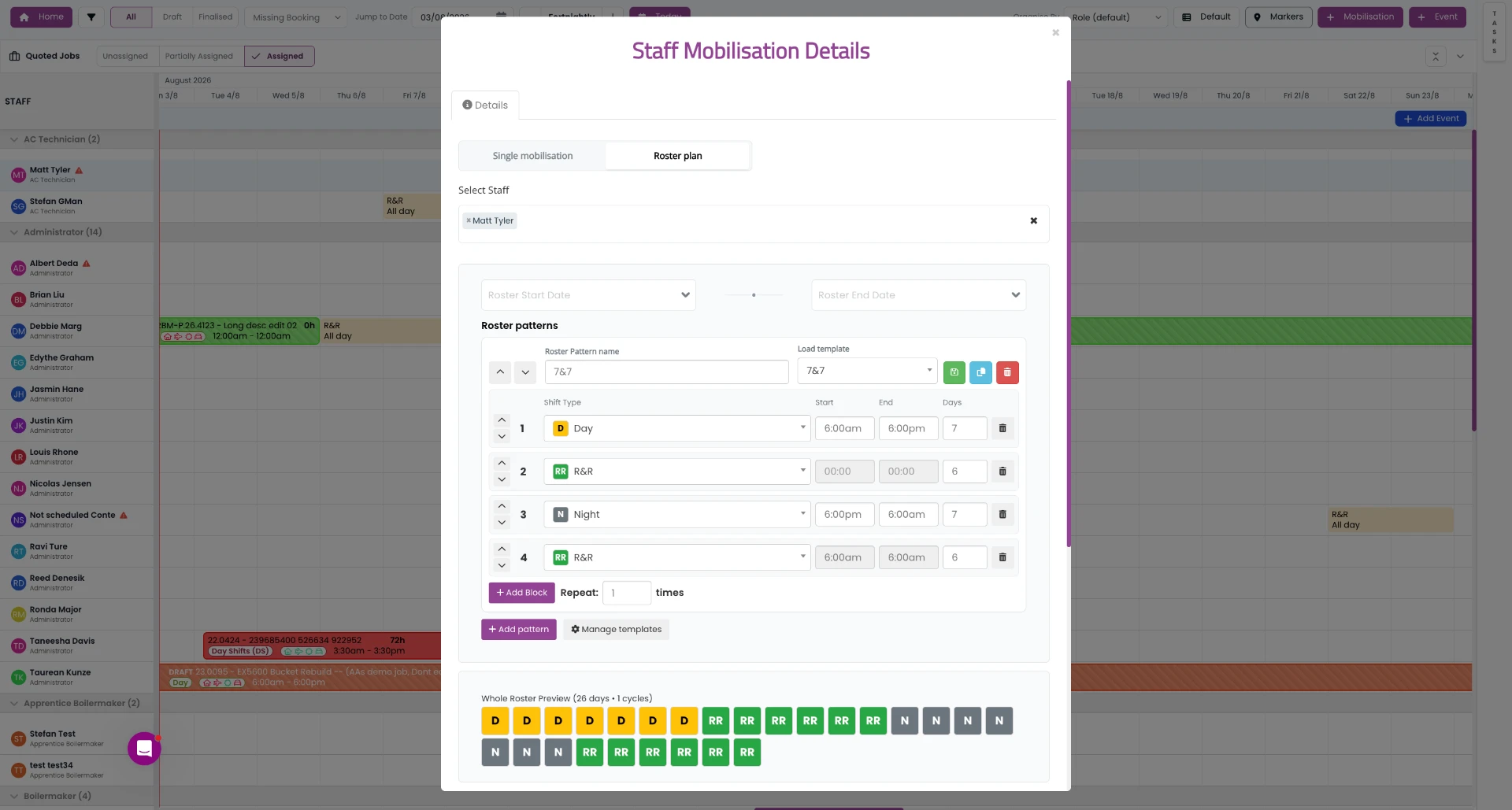
A FIFO roster is a repeating cycle of days on site and days at home for fly-in fly-out crews. To make one: define the coverage the site needs, choose a swing pattern (7/7, 8/6, 14/7, 2/1), calculate crews as cycle length ÷ days on, stagger them so cover never drops, then attach flights, camp beds, tickets, fatigue limits and award rules before publishing.
FIFO roster patterns explained
Australian mining runs a handful of standard swing patterns. Each is written as days on / days off, and the cycle length tells you how many crews you need to keep a position covered continuously.
| Pattern | Cycle | Typically used for | What it means in practice |
|---|---|---|---|
| 7/7 | 14 days | 24/7 production and maintenance crews | Two crews cover the site continuously. The most common even-time swing in Australian mining. |
| 8/6 | 14 days | Production, plant operators | Slightly longer swing than 7/7, still a two-week cycle — but crews overlap, so handovers are easier to staff. |
| 14/7 | 21 days | Remote WA and NT sites, long-haul FIFO | Fewer flights per worker per year, so travel cost drops — but fatigue risk and turnover both climb. |
| 2/1 | 21 days | Bowen Basin coal, drilling crews | Two weeks on, one week off. Cheap to run, harder to recruit for than even-time. |
| 9/5 | 14 days | Contractors and specialist trades | Common compromise where a full even-time roster isn't cost-justified. |
| 4/3 | 7 days | DIDO, regional workshops, residential crews | Weekly cycle that works when workers live within a bus run of site. |
How to build a FIFO roster: 8 steps
Define the coverage requirement first, not the pattern
Write down what the site actually needs: how many hours a day, how many days a week, how many people per shift, and which skills must be present on every shift. A 24/7 excavator maintenance crew needing two fitters and one auto-electrician per shift is a different roster problem to a day-only workshop. Coverage drives the pattern — never the other way around.
Pick a swing pattern that matches the coverage and the labour market
7/7 and 8/6 give you continuous cover on a two-week cycle. 14/7 and 2/1 cut travel cost on remote sites but are harder to recruit for. 4/3 works for DIDO crews within bus range. Check what your competitors in the same basin are offering — roster pattern is one of the top three reasons FIFO workers change employers.
Work out crew count and stagger the crews
For continuous coverage, crews = cycle length ÷ days on. A 7/7 roster on 24/7 operations needs two crews per shift position (four in total if you run day and night). Stagger crew start dates so one is always arriving as the other leaves — and check the maths across a full year, not one cycle, because public holidays and leave will break a roster that only balances on paper.
Map flights, buses and travel days
Every swing change is a travel movement. Decide whether travel days are paid, whether they sit inside or outside the days-on count, and lock the roster to the actual flight schedule out of Brisbane, Perth, Cairns, Townsville or Mackay. A roster that ignores the fact that there's no Sunday flight is a roster that puts someone on site a day late.
Allocate camp beds and site access at the same time
Camp capacity is a hard constraint, not a detail to sort out later. Build bed allocation into the roster so that when you add an extra fitter to a shutdown swing you find out immediately whether there's a room. Same for site access — vehicle passes, gate cards and area authorisations all need to line up with the swing dates.
Validate tickets, inductions and medicals before you publish
Check that every person rostered onto a shift holds a current site induction, medical, HRWL, confined space, working at heights or whatever the task demands — and that none of it expires mid-swing. This is the single most common cause of someone flying in and being turned around at the gate.
Apply fatigue rules and the award or EBA
Check maximum consecutive shifts, minimum break between shifts, night-shift limits, and the rest period after a night swing. Then check the roster against the award or EBA — penalty rates, shift loadings, LAFHA, site allowances and minimum engagement. A roster that breaches either one becomes a WHS finding or a wage claim, usually both.
Publish it, then control how it changes
Push the roster to workers with shift, site, flight and camp details attached — and give it a version. From that moment, every change should go through one process with one approver and one audit trail. Rosters don't fail when they're built; they fail in the three weeks of undocumented swaps that follow.
Fatigue and compliance guardrails
Maximum consecutive shifts
Most Australian mining fatigue policies cap consecutive 12-hour shifts somewhere between 7 and 14. Build the cap into the roster template so it can't be exceeded by an ad-hoc extension.
Minimum break between shifts
A minimum break — typically 10 to 12 hours — must survive travel time, not just the shift end time. A worker finishing night shift and flying home the same morning has not had a break.
Night-to-day changeovers
Rotating from nights to days inside a swing is a known fatigue risk. Where the pattern requires it, build in a dedicated rest period rather than assuming the crib break covers it.
The WHS record
Under the WHS Act, a PCBU must manage fatigue as a hazard. After an incident, the investigation will pull the roster: who was scheduled, how many shifts in a row, what breaks they had, whether it matched policy. The roster is a safety record.
Worked example: a 7/7 roster for a 24/7 maintenance team
Say the site needs two fitters and one auto-electrician on shift at all times, day and night. That is three people per shift, two shifts per day.
Twelve people plus float covers three roles around the clock. The same arithmetic scales: change the pattern and the crew count changes with it, which is exactly why you pick the coverage requirement before the pattern.
Common FIFO rostering mistakes
Spreadsheet or rostering software?
A spreadsheet is fine when…
You run one or two crews on a single pattern at a single site, one person owns the roster, travel is simple, and payroll is small enough to check line by line. A yearly swing template in Excel genuinely works at that scale.
You need software when…
You're juggling multiple sites, patterns and clients; tickets and inductions expire mid-swing; flights and camp beds have to move with roster changes; and rostered hours need to reach payroll without anyone re-typing them.
The dividing line isn't headcount — it's how many things have to change when the roster changes. Once a single swap means updating a flight, a bed, a gate pass and a timesheet, the spreadsheet has already stopped being the source of truth. That's the point at which employee rostering software built for FIFO and mining pays for itself.
Related reading: What are the most common FIFO rosters? · Employee rostering software for FIFO & mining · What is rostering software? · Rostering for mining & trade workers · Rostering apps vs contractor management software · Shutdown management in mining.