Quick Answer
The most common FIFO rosters in Australia are 8/6, 2/1, 7/7, 14/7, 9/5, 5/2/4/3 and 4/3. 8/6 (eight days on, six off) dominates Western Australian iron ore and gold; 2/1 (two weeks on, one week off) is the most common pattern in Queensland coal; and 7/7 even time is standard for 24/7 production and maintenance crews. Longer swings such as 14/7 and 15/13 are used at very remote sites where flights are expensive, while DIDO and residential crews typically work 4/3 or 5/2/4/3.
The most common FIFO roster patterns compared
A FIFO roster is written as days on / days off. The cycle length tells you how many crews are needed to keep a position covered continuously, and the days-per-year column is the practical difference workers feel in their pay and their time at home.
| Roster | Cycle | Shift | Typically used by | Days worked | What it means in practice |
|---|---|---|---|---|---|
| 8/6 | 14 days | 12 hours | Pilbara iron ore, gold operations, processing plants | ~209 days on/year | The single most common FIFO roster in Western Australia. Near even-time, and the two-day overlap makes handovers and relief easy to staff. |
| 2/1 | 21 days | 10–12 hours | Bowen Basin coal, drilling, civil and construction crews | ~243 days on/year | Two weeks on, one week off. Cheapest pattern per head because travel is spread over more shifts — and the hardest to recruit for. |
| 7/7 | 14 days | 12 hours | 24/7 production and maintenance teams | ~182 days on/year | True even time. Two crews cover one position around the clock, which makes crew maths simple and retention strong. |
| 14/7 | 21 days | 12 hours | Remote WA, NT and far-north QLD sites | ~243 days on/year | Fewer flights per worker per year, so travel cost drops sharply — but fatigue risk and turnover both climb. |
| 9/5 | 14 days | 12 hours | Contractors, specialist trades, maintenance providers | ~234 days on/year | A common compromise where full even-time isn't cost-justified but 2/1 won't attract the trades. |
| 5/2/4/3 | 28 days | 10–12 hours | DIDO and residential crews, regional workshops | ~234 days on/year | Alternating weeks that guarantee every second weekend off. Popular with residential and bus-in crews near Kalgoorlie, Mackay and Moranbah. |
| 4/3 | 7 days | 10–12 hours | DIDO, BIBO, regional field service | ~208 days on/year | A weekly cycle that works when workers live within a bus run or short flight of site. |
| 15/13 | 28 days | 12 hours | Very remote sites, offshore and long-haul FIFO | ~195 days on/year | Long even-time swing. Halves the number of travel movements a year but demands serious fatigue management. |
Each FIFO roster explained
8/6 — the WA default
Eight days on, six days off, repeating on a 14-day cycle. It dominates Pilbara iron ore and most large WA gold and processing operations. Workers get most of a week at home, the roster still fits a fortnightly payroll cycle, and the two extra days on give supervisors slack for training, handovers and relief without pulling someone off swing. Travel days are usually treated as days on, so a genuine eight-day swing often means about seven days at the workface.
2/1 — the Queensland coal workhorse
Two weeks on, one week off. It is the most common pattern across Bowen Basin coal contractors, drilling crews and civil packages, largely because it delivers the most productive days per worker per flight. It is also the pattern workers leave first when an even-time job comes up, so operators running 2/1 usually pay a premium or offer a path onto a better roster.
7/7 — even time
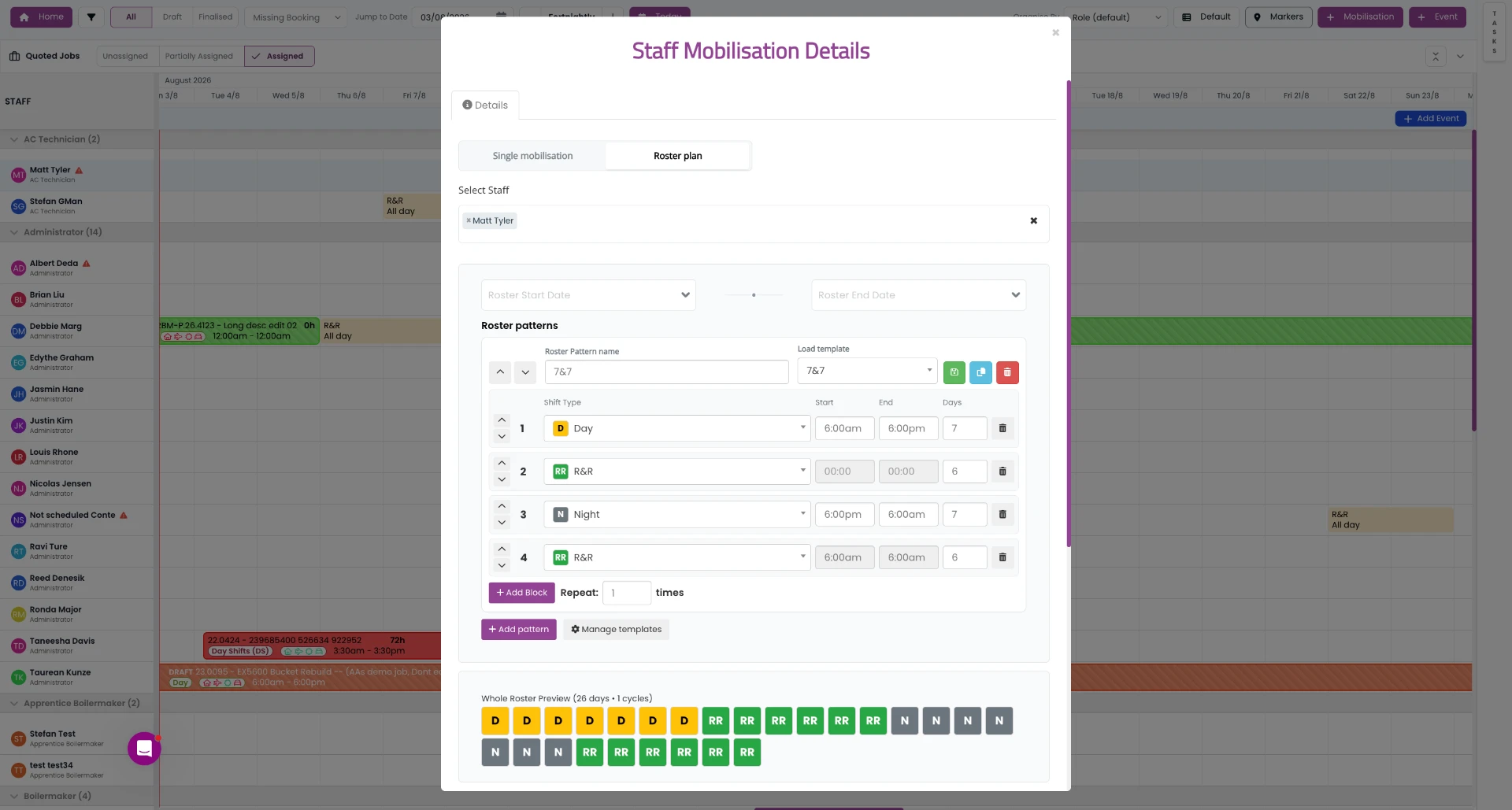
Seven days on, seven off. The cleanest roster to build: 14 ÷ 7 = two crews cover a position continuously, four crews if you run day and night. Even time is the strongest retention lever in Australian mining because workers can plan a stable home life around it, and it is increasingly used to attract experienced trades and women returning to site-based work.
14/7 — the long remote swing
Fourteen on, seven off, on a three-week cycle. Common at very remote WA and NT sites where a return charter is expensive. Fewer flights means lower cost, but 14 consecutive 12-hour shifts sits at the top of most fatigue policies, so night-shift limits, break rules and mid-swing rest days matter more here than on any other pattern.
9/5 and 5/2/4/3 — the compromises
9/5 keeps a fortnightly cycle while buying four extra shifts a swing compared with 7/7. 5/2/4/3 alternates a five-day and four-day week so every second weekend is free — the pattern of choice for DIDO and residential crews in Kalgoorlie, Mackay, Moranbah and Emerald where people drive or bus rather than fly.
4/3 and shutdown rosters
Short 4/3 cycles suit DIDO and regional field service. Shutdowns are different again: a shutdown roster is not a standing pattern at all but a fixed campaign — often 14 to 28 straight days of 12-hour shifts with a hard end date, staffed by contractors flown in specifically for the window.
Which roster suits which type of work
What's changing in 2026
Managing common FIFO rosters in practice
Crew maths
Crews per position = cycle length ÷ days on. 7/7 needs two crews; 8/6 needs slightly under two, which is why the overlap days get used for relief. Add 10–15 percent float for leave, training and sickness or the roster breaks inside the first month.
Swing handovers
Whatever the pattern, the swing change is the risk point. Build a face-to-face overlap so outgoing crews hand over live work, isolations and permits rather than leaving a note in the crib room.
Fatigue limits
Long-swing patterns (14/7, 2/1, 15/13) need explicit caps on consecutive shifts, minimum breaks that survive travel time, and controlled night-to-day changeovers. Under WHS law the roster is a safety record.
Tickets and camp beds
Every pattern change moves flights, beds and gate passes. Check that no induction, medical or HRWL expires mid-swing before the roster is published — it is the most common reason someone flies in and gets turned around.
Picking the pattern is the easy part — running it is where rosters fall over. If you want the method behind building one from scratch, read how to make FIFO rosters, then look at employee rostering software for FIFO and mining once a single swap means updating a flight, a bed, a gate pass and a timesheet.
Best roster for retention
Even time — 7/7 or 8/6. Predictable time at home is consistently the strongest non-pay reason FIFO workers stay with an employer, and the crew maths is the simplest to build and audit.
Best roster for cost
2/1 or 14/7. More productive days per travel movement, so charter and accommodation cost per shift drops — offset it against higher turnover and heavier fatigue controls before you commit.
Related reading: How to make FIFO rosters · Employee rostering software for FIFO & mining · What is rostering software? · Rostering for mining & trade workers · Shutdown management in mining.